The chain purpose-built forCredit at scale

Where risk clears first, credit can go further.

Why build a chain?

Lending is a risk business. On a general-purpose chain, a liquidation waits in the same line as a token mint, the dollar belongs to someone else, and every protocol guards only its own solvency. Arch Network was built so risk clears first.

Built for clearing

A lending book is only as good as its worst hour. Every feature of the chain exists to make that hour boring: liquidations first, collateral that can be enforced, and a dollar the network issues itself.

The risk engine

Other lenders manage risk by being conservative. Arch manages it with structure: every account priced continuously, every breach closed out mechanically, every dollar of repayment minted on the spot. That structure is what lets Arch lend more against the same collateral.

What clearing makes possible

When the whole trade sits inside one risk perimeter, credit gets cheaper and deeper: higher loan-to-value, tighter buffers, leverage on yield. Arch Prime is the first tenant built on it.

Credit needs its own chain.

Four things a rented chain can't do.

Every lending protocol on a general-purpose chain guards its own solvency and nothing else. When prices crash, each one does exactly what it was built to do, so they all lend conservatively: lower loan-to-value, wider buffers, wider spreads. Arch Network puts the whole trade inside one risk perimeter.

Integrated
One risk perimeter.

Lending, execution, vaults and the dollar live in one stack that sees the whole trade, so it can extend more credit against the same collateral.

Prioritized
Liquidations go first.

On a rented chain a closeout waits behind a token mint. Arch orders risk ahead of everything that carries none.

Enforceable
Collateral the lender can actually reach.

Native Bitcoin stays on Bitcoin at its own address, and the network can still close it out. Nobody else's stack can say that.

Deterministic
Recovery is certain, not best-effort.

No single party can move a coin, and no single party can stop a liquidation. A validator threshold signs together.

Anatomy of a liquidation.

DetectPrioritizeSignSettle

One liquidation, step by step: detect, prioritize, sign, settle.

Collateral chainYour collateralA real output on its own chain.Not a claim on one.
1 health factor
per account
Every block
every account re-checked
0 IOUs
a real output, not a claim
The breach

The chain sees it first.

Every account is re-priced every block. When health crosses the line, the chain already holds the collateral it needs to act on, a real output, not a claim on one.

180ms
blocks
1st in block
liquidations go first
0 auctions
for block space
The queue

Risk jumps the line.

Apps fire transactions. The chain sorts them, and closeouts go to the front of the next block, never behind a mint or a meme.

1 signature
the closeout, at the breach price
0 single keys
no party can sign alone
FROST·ROAST
threshold signing
The signature

Price locks at signing.

The validator threshold signs the closeout at the breach price. No single party, Arch included, can sign it alone or stop it.

Closeout clears (seconds)Final on its own chainaUSD
<3s
closeout
1 motion
sell, mint and repay
Next block
final on its own chain
The closeout

Seconds to repay.
Final on its own chain.

Collateral is sold across the markets the desk connects to, and aUSD is minted against the proceeds to repay the loan in the same motion. No bridging dollars back. The collateral's own chain finalizes it in its next block.

The pieces only work together.

Priority, ledger liquidations and a native dollar. Any one of them alone is a feature. Together they are why credit on Arch can scale.

DeFi split credit into silos. Arch puts it back in one book.

Lending, vaults, swaps and the dollar usually live in separate protocols that don't see or trust each other, so each prices its own worst case. On Arch they share one balance sheet and one view of the trade.

lending → book ← vaultsswaps → book ← the dollarvaults → book ← lendingthe dollar → book ← swapslending → book ← swapsvaults → book ← the dollarLendingVaultsSwapsThe dollarOne bookOne balance sheet, one view of the trade

Collateral you can actually enforce.

A loan market only works if the lender can close a position without the borrower's consent. Arch does it mechanically, and for native Bitcoin it does it without ever taking possession. Bitcoin carries the most credit because it's the collateral Arch is most sure it can liquidate.

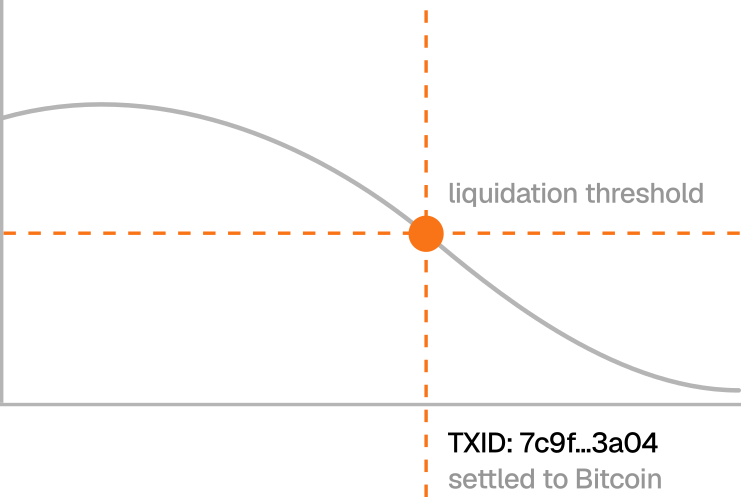
A price line crosses the liquidation threshold; the VM assembles a Bitcoin transaction that moves the collateral.

A liquidation is a ledger operation, not a scramble.

A late liquidation is a loss. Arch detects the breach, locks the price at signing, sells across the desk's connected markets and mints aUSD against the proceeds to repay, in seconds. Then it settles on Bitcoin.

aUSDSold acrossconnected marketsNot a scramble for liquidity.A ledger operation.

Credit at scale, on its own chain.

Siloed lenders manage risk with conservatism. Arch manages it with structure, which is why it can lend more against the same collateral.

Priority lanesEnforceable collateralLedger liquidation + aUSDHigher LTV, tighter spreads

Built for credit. Open to build on.

Arch Prime is the first tenant. It won't be the last.

For builders

Build on the clearing chain.

Launch a credit product that clears on the same risk engine.